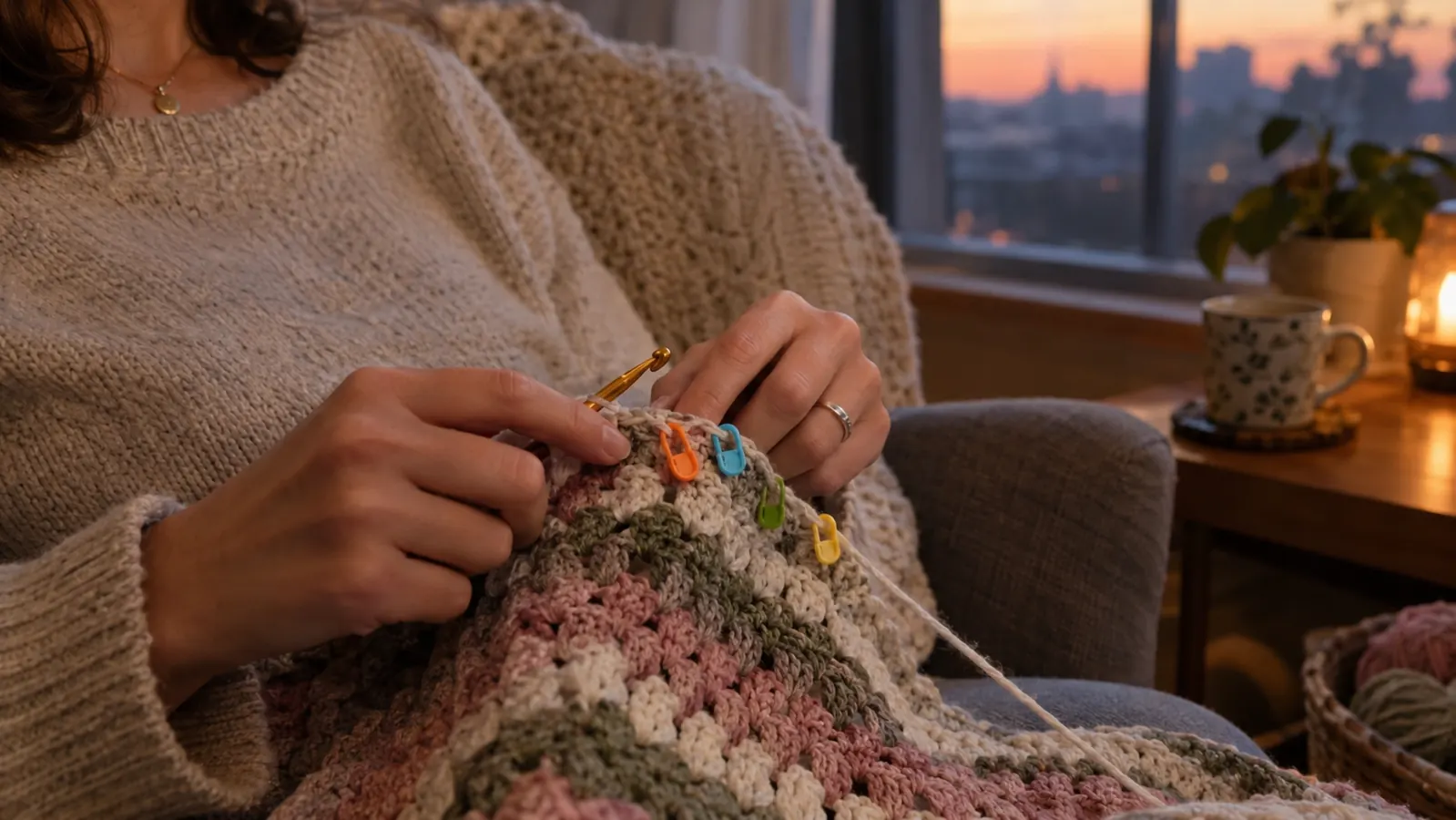
I lose track of my place in a pattern about three times per evening. I count to row twelve, the phone rings, the cats notice the yarn, and suddenly I am counting again from the start. It got so bad last spring that I frogged an entire afghan because I could not trust my own counting. That is why I finally ordered a set of HiMo locking stitch markers, and why I am writing this review after using them nearly every night for four months instead of after one enthusiastic afternoon.
HiMo sells these in a 100-piece mix, and at the current price they are one of the cheapest tools in my crochet bag. But cheap tools either disappear into a drawer or earn their place. These earned it.
The Quick Verdict
The best locking stitch markers I have used in 30 years of crochet. They stay put, they are easy to open one-handed, and the 100-piece mix means I always have one within reach. The only real drawbacks are the soft plastic that can bend if you force it and the fact that the colors are random.
Amazon Check Today's Price →Stop recounting rows and start finishing projects
I bought a 100-piece HiMo mix and still reach for the same handful every night. If you crochet more than once a week, this is the cheapest upgrade to your finishing rate you will make all year.
Amazon Check Today's Price on Amazon →How I've Used It
My name is Delphine, and I have crocheted for about 30 years, mostly afghans and throw blankets, with amigurumi and dishcloths when I need a small project. I work in an armchair by the living room window with a side table for my hooks, my glasses, and a cup of tea. My Afghan hound Stormy sleeps near my feet, and my cats Romeo and Juliette are convinced every strand of yarn is a toy. Loose markers would be cat toys. Locked ones are not.
I used these markers on four finished projects and two that are still in progress, plus a round of amigurumi where I needed to mark increase rounds. That is roughly 120 hours of use. I clipped them onto stitches, onto the edge of my work, and onto the loop of a stitch I needed to come back to. I also left a few clipped to a project in my project bag for two weeks straight to see if they would stay put.
I started small before I trusted them on anything important. I clipped three markers onto a dishcloth I was making for a neighbor and left it in the project bag for a full week. Then I carried the bag to the grocery store, to the post office, and back home. The markers stayed exactly where I had put them. Only after that test did I use them on the granny square blanket that had been sitting half-finished in my bedroom closet since March, because I had lost my place one too many times and frogged three rows in frustration. The amigurumi test came in October, when I made a small octopus for a friend's grandchild. That pattern called for a marker at every increase round, and with eight legs to track, I needed a different color for each section.
The verdict from that test: they stayed exactly where I put them. Not one marker fell off, even when the project bag got tossed into the back seat of my car and then carried into the doctor's waiting room. That alone is the whole job, and HiMo gets it right.
What Makes a Locking Stitch Marker Lock
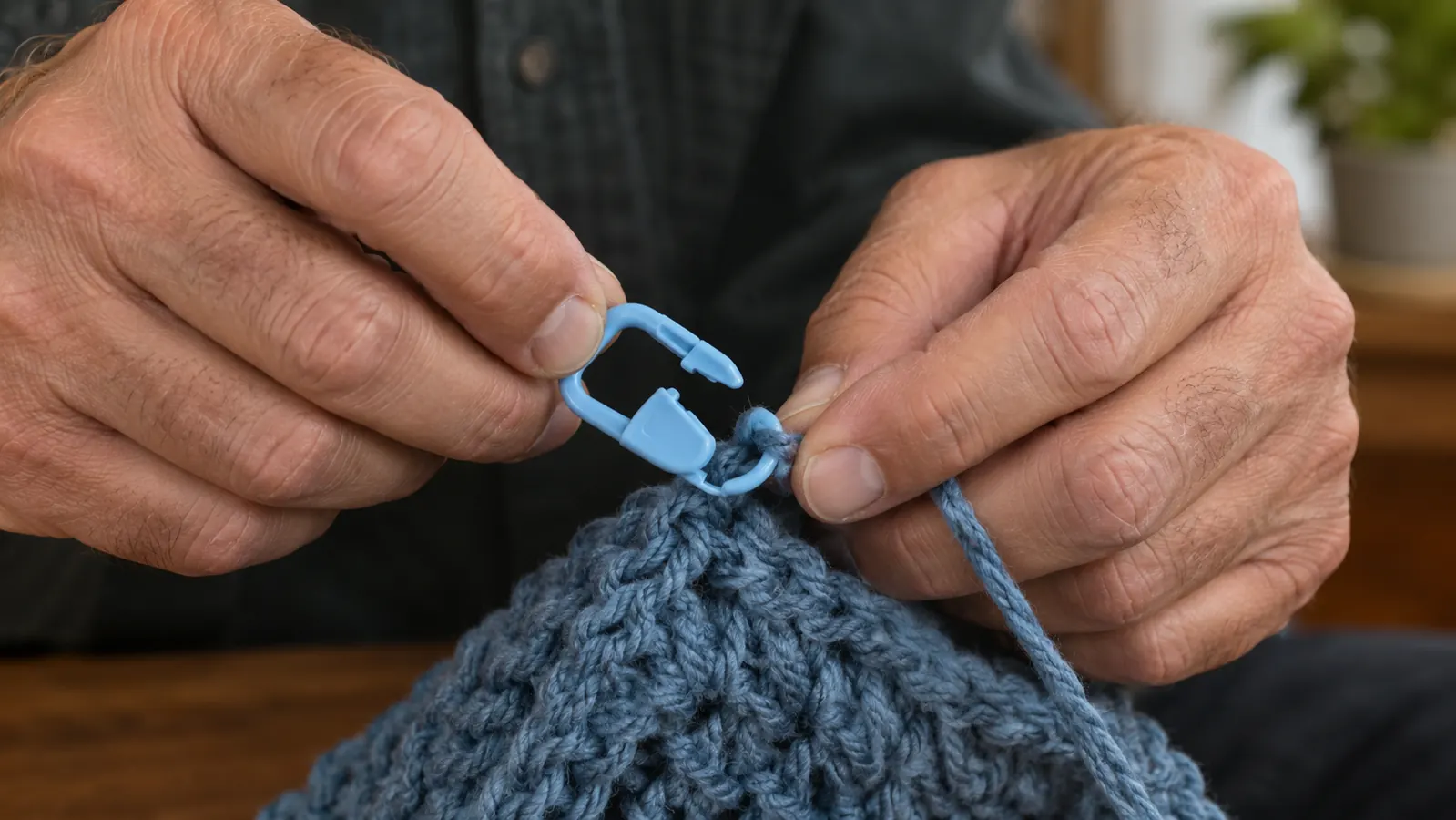
A locking stitch marker is a small clip with a spring or a hinge that closes completely around the yarn. Unlike a split ring or an open marker, it cannot slide off the end of a row or fall out when you fold your work. The HiMo version is a plastic clip with a little locking arm that you squeeze open, place over the stitch, and release. The arm clicks shut over the yarn.
The opening is just wide enough for worsted weight yarn, which is what I use for most of my blankets. On sport weight yarn, like the baby blanket I made last month, the clip closes a little tighter, and you can feel it grip the strand. On bulky yarn, I worried the same opening would be too small, so I tested it on a swatch of chunky yarn from my stash. The marker opened wide enough to clip on, and it held through a dozen folds. The whole marker is about the size of a small paperclip, so it adds no bulk to your work. You can fold a blanket with markers in place and not feel them through the fabric.
The important detail is the shape of the opening. When the marker is closed, the yarn sits inside a fully enclosed loop. That is what makes it different from the cheap open markers that look like tiny safety pins. Those work fine until you move your project, and then they work less fine. I have found HiMo markers on the floor, in the couch cushions, and once in Stormy's water bowl, but never still attached to a stitch that had come undone.
Before these, I used split ring markers for years, the kind that look like tiny key rings. They work, but they have one flaw: they slide along the yarn. I cannot count how many times I picked up a project and found my marker had crept three rows down from where I left it, marking the wrong stitch entirely. The HiMo marker cannot do that. The clip closes around a single loop of yarn and stays on that loop, no matter how many times you fold, toss, or carry the project.
The plastic is soft enough to squeeze without hurting my arthritic right thumb, which surprised me. I expected something stiff and painful after a long evening. Instead, the clip opens with a light press, and the locking arm snaps back with a satisfying click. The click matters more than you would think, because you can hear that the marker is closed without looking away from your work.
The 100-Piece Mix and How I Actually Use It
The set comes with 100 markers in a mix of colors. You do not get to choose the colors, which is the one thing I would change if I could. You also do not know how many of each color you will get. My set arrived with a generous pile of bright pink and turquoise, a smaller pile of yellow and green, and a handful of clear ones.
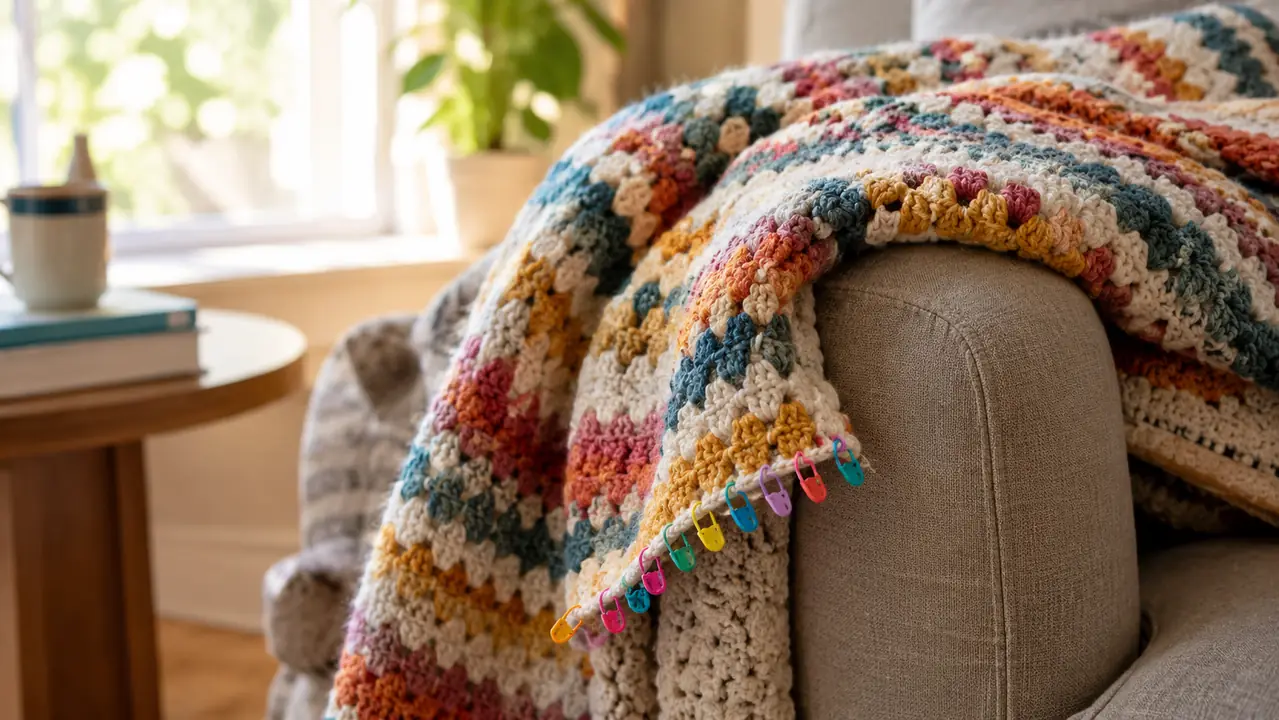
The random colors turned out to be a feature. The color system took shape by accident one evening. I was working on the corner-to-corner blanket and needed three markers at once: one for the row I was on, one for the next increase, and one for a dropped stitch two rows back that I needed to fix. I grabbed three markers without looking, and they happened to be pink, turquoise, and clear. After that I started choosing colors on purpose. Now pink means the row I am currently working, turquoise means the next increase, yellow marks corners and pattern repeats, and clear marks a stitch I need to rip out and redo. When I look down at my work, the color tells me what the marker means, no counting required.
The clearest proof that the system works came on that same blanket. The pattern repeated every twelve rows, and I kept losing track of which repeat I was on. I clipped a yellow marker at the start of each repeat and moved a pink marker up one row every time I finished a row. By the end of the evening I could glance at the work and know exactly where I was. I finished that blanket in November, and it is the first large project in years that I did not have to frog even once.
I keep my everyday markers in an old mint tin on the side table next to my armchair, about fifteen at a time. The tin came from a yard sale years ago, and it is the right size for a handful of markers. The rest of the hundred live in a zippered pouch in my project bag. I refill the tin when it runs low, which happens less often than you would think because the markers stay on the projects they are clipped to. At 100 pieces, I do not worry about losing one. That is the real benefit of the big mix. You stop treating markers like precious objects and start using them liberally, which is exactly what you should do.
The clear markers are the ones I reach for least, because they are hard to see against light yarn. I use them only for stitches I need to rip out, where I am looking closely anyway. If I could order a set in all one color, I would probably choose turquoise, but I have learned to work with the mix.
What I Learned About Durability Over Months of Use
Here is the honest part. The HiMo locking stitch markers are not indestructible. The plastic locking arm is thin, and if you force it open backward or sit on a marker, it can bend. I know this because I managed to bend three of mine in the first month, and all three still worked after I bent them back, which surprised me.
The first bend happened on a Tuesday evening in September. I was holding a half-finished afghan in one hand and a cup of tea in the other, and I needed a marker from the tin. Rather than put the tea down, I tried to open the marker with my teeth. The locking arm bent sideways. I straightened it with my thumbnail, and it has clicked shut fine ever since, though I do not open markers with my teeth anymore. The other two bends were my own fault too. I had left a loose handful of markers in the bottom of my project bag, then carried the bag to my car and sat down without thinking. When I opened the bag later, two markers were bent. I bent them back with my fingers, and both still close tight.
I also tested them the hard way without meaning to. Twice I finished a blanket, washed it, and only noticed afterward that I had left markers clipped to the edge. Both times the markers came through the wash fine. The colors did not run onto the yarn, and the clips did not warp. I do not recommend washing markers on purpose, but it is good to know a mistake will not ruin a finished piece.
I also learned that the markers with the softest plastic are the easiest to open but the most likely to bend. The tradeoff is worth it for my hands. A stiffer marker would last longer and hurt my thumb more. I will take replaceable over painful every time, and with a hundred in the pouch, I can afford to.
After four months, I have 95 intact markers in the tin, three that I bent and straightened, one that I lost in the couch, and one that Romeo batted under the radiator. Out of a hundred markers, two are genuinely gone, and the three bent ones still work. I consider that excellent.
What I Liked
- Locking clips stay on the stitch through folding, carrying, and even an accidental trip through the wash
- Soft plastic opens with a light press, easy on arthritic thumbs
- 100 pieces means you can use them liberally and lose a few without worry
- Mixed colors let you build a simple color-coding system
- The click tells you the marker is closed without looking away from your work
Where It Falls Short
- Colors are random; you cannot choose the mix or order more of one color
- Soft plastic can bend if forced open backward or sat on
- Small size means the occasional marker ends up in a couch cushion or under a radiator
- Clear markers are easy to lose against light yarn
Four months of daily use, roughly 120 hours of crochet, and not one HiMo marker has fallen off a stitch.
Who This Is For
Buy these if you crochet or knit anything where you need to mark a stitch and come back to it later. If you make blankets, you will use them for counting rows and marking pattern repeats. If you make amigurumi, you will use them to mark increase rounds. If you knit, you will use them as locking stitch markers that do not fall off your needles when you set your work down. A knitter friend borrowed a handful for a sweater and ordered her own set within the week.
They are also for anyone who has ever found a split ring marker on the floor and wondered where it came from. The locking design means the marker stays on the stitch, not on the carpet. That is the whole reason to choose HiMo over a pack of safety pins, and it is a good reason.
Who Should Skip It
Skip these if you only crochet straight rows and never need to mark your place. If you finish a project in one sitting and never set it down, you do not need 100 markers, and a single split ring marker will do the job. A friend of mine crochets like that, fast and straight through to the end, and she has never needed more than one marker in her life.
Skip them if you dislike random colors and want a coordinated set for your project bag. These come in a mix, and you cannot choose. If that will bother you, look for a smaller set in a single color instead.
And if you have hand pain that does not settle down, please see a doctor or a hand therapist. A soft clip helps, but no stitch marker is a treatment for arthritis. I say that as someone who lives with achy thumbs and has learned to be careful.
The 100-piece set that ended my row-counting habit
Four months in, I reach for the same tin of HiMo markers every single evening. They lock, they last, and the mix of colors means I never run out of the one I need.
Amazon Check Today's Price on Amazon →