If you have ever stood in front of a yarn wall with a pattern in one hand and no idea which hook to grab, you are not alone. I have been crocheting for about thirty years, and I still see crocheters guess wrong on hook size and then blame themselves when the fabric comes out stiff or full of gaps. The truth is simpler than most tutorials make it sound. Hook size is not a personality test. It is a measurement you can learn to read, and once you know how to read it, the Clover Amour set makes the whole thing feel obvious.
I bought my first set of Clover Amour hooks after a friend let me try one at a stitch group. I had been using the same aluminum hooks since the 1990s, the ones with the flat metal handles that dig into your thumb joint after an hour. My right thumb has mild arthritis, so I notice that kind of thing fast. The Amour hooks did not cure my arthritis, and I am not going to pretend they did. But they did change how long I could crochet before my hand complained. This guide is about the part that trips people up first: picking the right size for the project, not just the prettiest hook in the case.
Start with the right size and your hands will thank you.
The Clover Amour set covers ten sizes, so you can test a few before you commit to a full project. Check today's price on Amazon and see the full size range.
Amazon Check Today's Price on Amazon →Step 1: Read the yarn label before you touch a hook
Every skein of yarn has a label for a reason. The label lists the yarn weight, the fiber content, and a recommended hook size. That recommended size is not a suggestion from a marketing team. It is the size the yarn company used to make the fabric behave the way the yarn was designed to behave. If you hold a skein of worsted weight yarn and the label says 5.5 mm, that is your starting point.
I keep a small notebook in my yarn basket, and the first line for every new yarn is the label's recommended hook. When I started doing this, I stopped guessing. I also stopped ripping out entire blankets because the tension was off. The label will not tell you the perfect size for every pattern, because drape matters too, but it gives you a sane place to begin.
One thing I tell people at the yarn circle: the label is a starting point, not a rule carved in stone. I have a box of dishcloth cotton where I deliberately use a smaller hook than the label suggests because I want a denser fabric that can stand up to scrubbing. But you need a starting point before you can make a deliberate change. The label gives you that.
Step 2: Match the hook to the fabric the pattern wants
Think about what you are making. A washcloth and a lace shawl want opposite things from the same yarn. A tight, dense fabric is great for amigurumi, because you do not want stuffing poking out between stitches. A loose, drapey fabric is better for a summer shawl, because you want it to flow over your shoulders.
The pattern usually tells you which it wants. If the pattern calls for a 4 mm hook and you use a 5.5 mm hook, your gauge will be off, and the finished piece will be larger than the pattern intended. That matters for anything that has to fit, like a sweater or a hat. For a blanket it matters less, but it still changes how the fabric feels.
When I make afghans, I usually start with the size the pattern suggests, then make a small swatch and hold it up. If the fabric feels like cardboard, I go up a hook size. If it feels like it will stretch out of shape, I go down. The Clover Amour set makes this easy because the sizes are marked clearly on the handle, so I can switch without squinting at a tiny number.
Step 3: Let your hands vote on the handle, not just the size
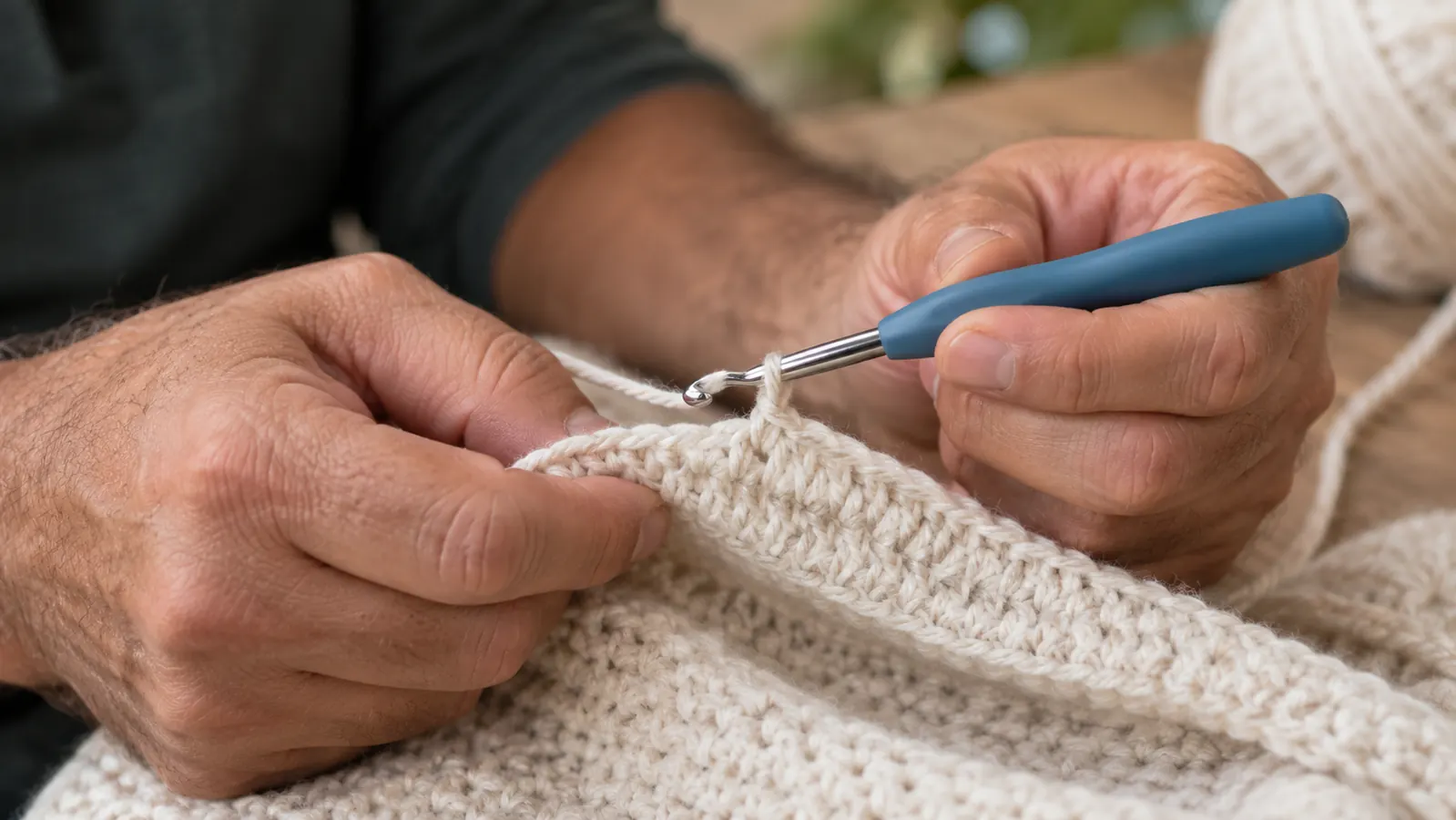
Here is the part most hook size guides skip. The number on the hook matters, but so does how the hook feels in your hand. I have mild arthritis in my right thumb joint, and the thin aluminum hooks I used for years made it worse. When I switched to the Clover Amour hooks, the difference was immediate, not because the handle is special, but because the handle is thicker and softer, so my hand does not have to grip as hard.
Try this: hold the hook the way you actually crochet, not the way you hold it for a photo. Make a few chains. Does your thumb slide into a comfortable spot? Does the hook feel balanced? If a hook makes your hand cramp after ten minutes, no size chart in the world is going to save the project.
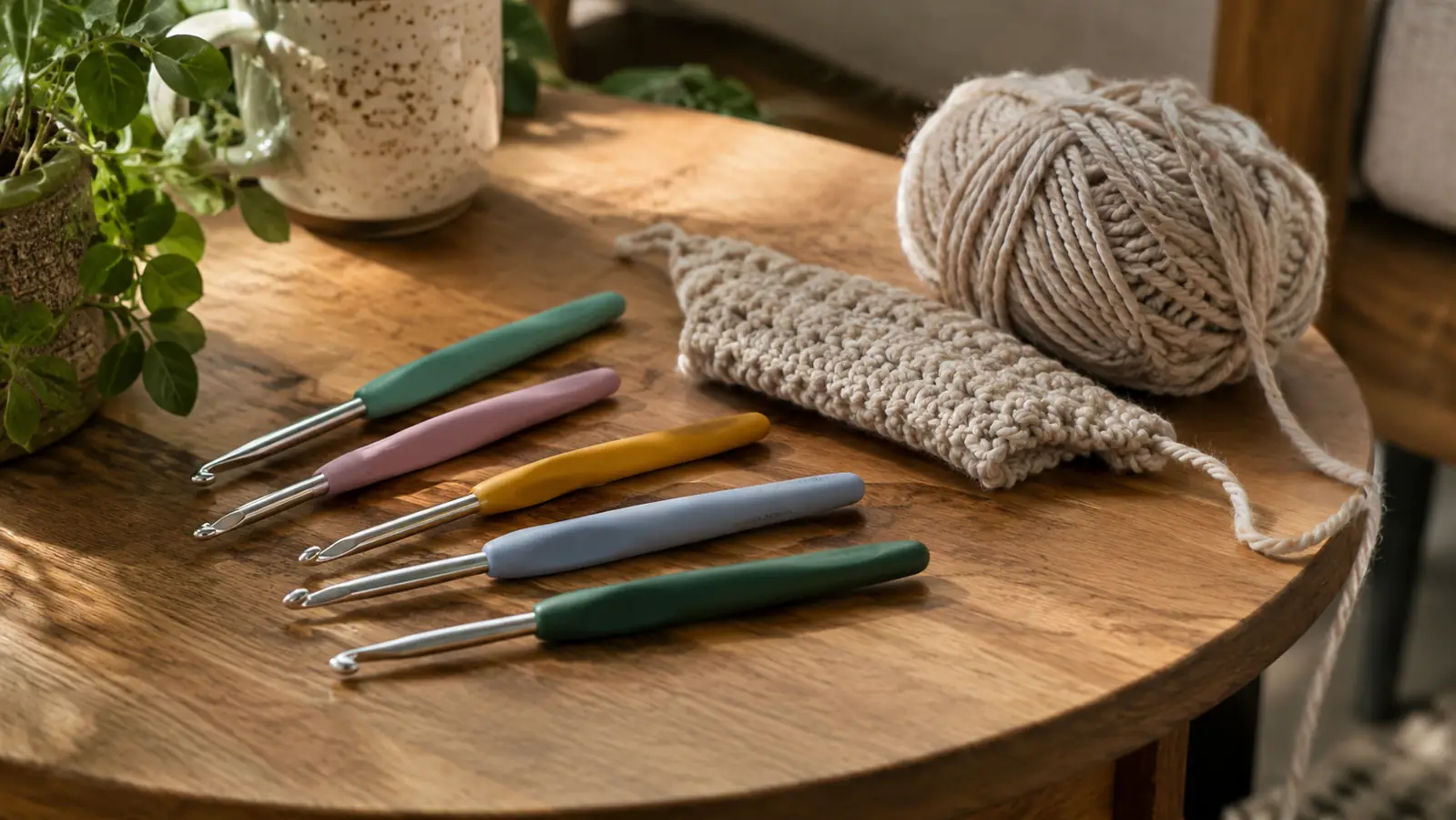
This is also why I recommend a set instead of a single hook. You can compare sizes side by side without getting up. The Clover Amour set has ten sizes, and I have used all of them at one point or another. Even the sizes I do not reach for often earn their place in the case.
Step 4: Test the size with a real swatch, not a guess
A swatch is just a small square of fabric worked in the pattern stitch. It takes fifteen minutes and it saves you from ripping out hours of work. Make a swatch with the hook size you think you want, then another swatch one size up and one size down. Lay them side by side. The right size is usually obvious when you see the fabric instead of imagining it.
I do this for every afghan I start, and I have been crocheting for thirty years. It is not a beginner habit. It is a professional habit. The swatch tells you about gauge, drape, and stitch definition before you commit to a whole blanket.
When I use the Clover Amour set, I keep the swatches pinned to the pattern page with the hook size written next to them. That way, if I put the project down for a month, I know exactly where I left off. Future Delphine thanks present Delphine every single time.
Step 5: Keep a hook size journal for the yarns you love
After a few projects, you will notice patterns in what works. My favorite worsted weight yarn, the one I use for most afghans, always looks best with a 5.5 mm hook. The sport weight cotton I use for dishcloths wants a 4 mm hook. I would not remember any of this without my notebook, because I buy the same yarns over and over and my memory is not that good.
Your journal does not need to be fancy. A spiral notebook works. Write down the yarn, the hook size, and one sentence about how the fabric came out. After a year, you will have a personal reference that is more useful than any chart on the internet, because it is calibrated to your tension and your hands.
The Clover Amour set helps here too, because the size is printed on the handle in a way I can actually read without my glasses. I know some people complain the print wears off over time. I have not seen that on mine, but I also do not toss my hooks around loose. I keep them in the case they came in.
What Else Helps
The right hook size solves most tension problems, but it is not the only thing that makes a project feel good. I use a yarn bowl for the balls of yarn that like to roll across the floor, mostly because my cats, Romeo and Juliette, think a moving ball of yarn is a toy. A good light matters too. I crochet in an armchair by the window in the living room, and the afternoon light is fine, but on cloudy days I use a small floor lamp.
I also take breaks. Every thirty minutes or so I put the hook down, stretch my fingers, and shake out my hands. It is not medical advice, just what I do. If your hands hurt and it does not go away, please see a doctor or a hand therapist. No hook is worth your hands.
And if you are wondering whether you need the whole set, start with the sizes you actually use. For me, that is 4 mm, 5 mm, and 5.5 mm. The rest of the set is insurance for the day I try a new yarn and need a 6.5 mm hook. That day comes more often than you expect.
I also keep a small measuring tape in my hook case. When I finish a swatch, I measure it against the pattern gauge. It takes ten seconds and it catches problems before they become a whole blanket. I have a friend who never measures and she has a closet full of afghans that are all a little too small or a little too big.
How I Use the Clover Amour Set in Real Projects
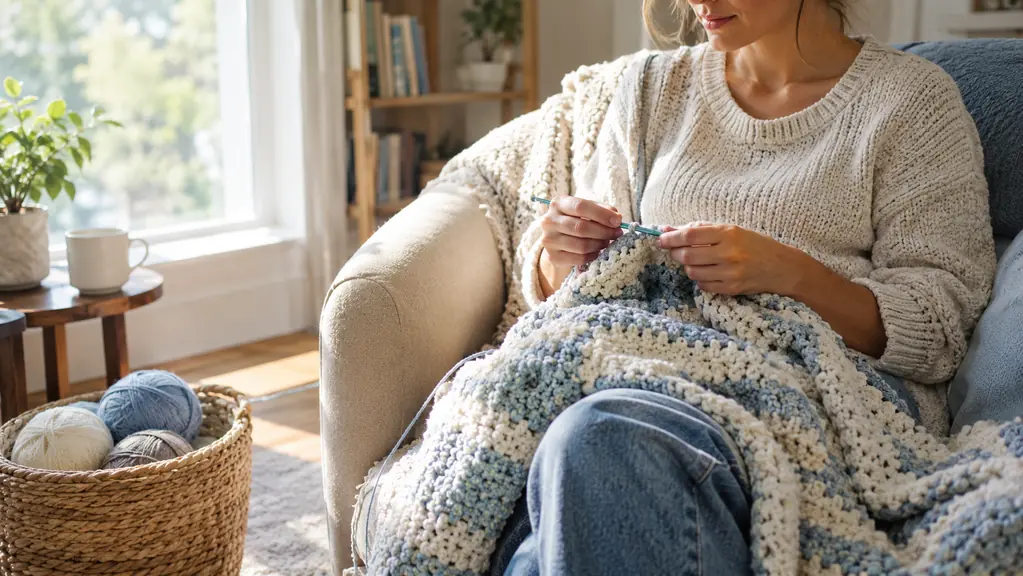
Right now I am working on a throw blanket for my couch in a worsted weight yarn. I started with a 5.5 mm hook, made a swatch, and decided the fabric was a little too stiff for a couch blanket. I switched to a 6 mm hook and the same pattern softened up exactly the way I wanted. That is a ten minute fix that would have been a whole wasted blanket if I had skipped the swatch.
For amigurumi, I go the other way. My cats, Romeo and Juliette, have a basket of little crocheted toys, and I use a 3.5 mm or 4 mm hook for those so the stuffing stays inside. The smaller hook also makes the stitches tight enough that the toys hold their shape after the cats bat them around.
The hook case itself lives on my side table next to my armchair. Stormy, my Afghan hound, has a long silky coat that sheds, so I keep my yarn in a bag with a lid and I brush the finished pieces off before I gift them. The hooks themselves are easy to wipe down, which matters in a house with two cats who like to sit on the table.
A Few More Hook Size Questions
What if the pattern calls for a hook size you do not own? Use the closest size you have and make a swatch first. The swatch will tell you whether the substitution works. If your fabric is much tighter or looser than the pattern photo, adjust from there. This is exactly why a set of ten sizes is handy.
What does gauge mean? Gauge is the number of stitches and rows per inch or per four inches. Patterns list a target gauge so your finished piece ends up the right size. If your gauge is off, the finished piece will be off by the same percentage. A swatch is the only way to know before you invest hours.
Do you need a different hook for different yarn weights? Yes. A bulky yarn needs a bigger hook than a fingering weight yarn. The Clover Amour set covers a useful range, and I have used the smaller hooks for fine cotton and the larger ones for chunky blankets.
Can you use the same hook for every project? You can, but the fabric will not always look right. A hook that works for a loose shawl will make a dense amigurumi feel stiff, and a hook that works for amigurumi will make a shawl feel like cardboard. Matching the hook to the project is the difference between a blanket you finish and a blanket you shove in a closet.
What I Would Tell a Friend Starting Out
If you are new to crochet, do not buy one hook and assume it is the only size you will ever need. Start with a set, even if it feels like more than you need today. The Clover Amour set has ten sizes, and the cost per hook is much lower than buying singles. More importantly, you will actually use most of them within the first year.
And do not let the size numbers intimidate you. The millimeter number is just the diameter of the hook shaft. Bigger number, bigger hook, looser fabric. Smaller number, smaller hook, tighter fabric. That is the whole system. Everything else is practice and swatches.
The difference was immediate, not because the handle is special, but because my hand did not have to grip as hard.
Pick your size, then let the hook do the work.
The Clover Amour set gives you ten sizes to test, so you can find the one that makes your hands happy. Check today's price on Amazon and see the full size range.
Amazon Check Today's Price on Amazon →