I bought a pack of 100 HiMo locking stitch markers back in March, mostly because I was tired of counting rows in my head and losing my place on a blanket that all looked the same shade of blue. Six months later, I have used them on afghans, amigurumi, and a stack of dishcloths for Christmas gifts. I also have some honest opinions about them that the product page does not mention. This is the review I wish I had found before I clicked buy.
The Quick Verdict
The HiMo locking stitch markers are a genuinely good, inexpensive tool that does its one job well. They are not magic, they are not all equally easy to open, and a few of them will make you mutter. But for the price of a sandwich, they fixed my row counting for good.
Amazon Check Today's Price →Stop losing your place on row 47
A hundred locking stitch markers, one small pouch, and no more counting in your head. This is the pack I still reach for every evening.
Amazon Check Today's Price on Amazon →How I've Used Them
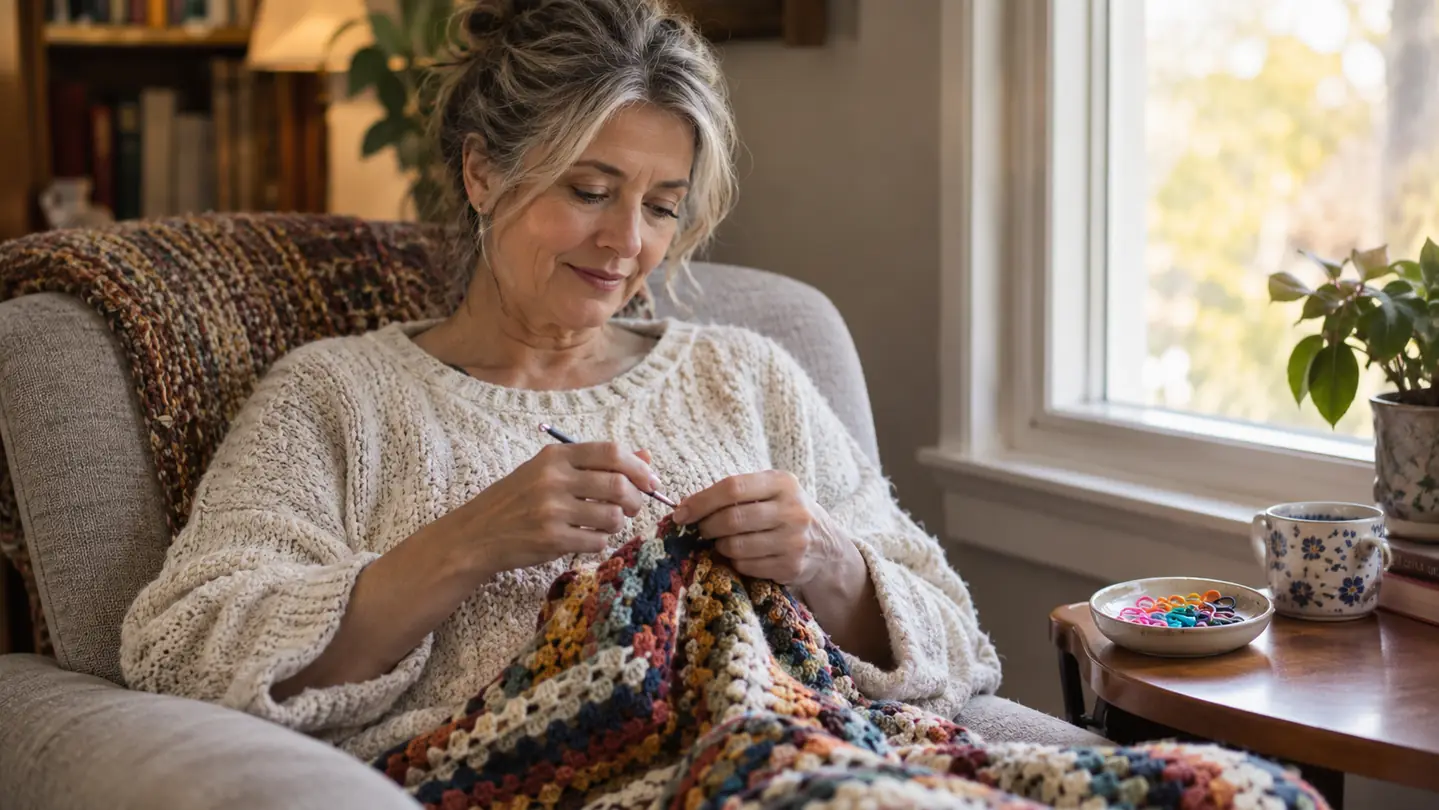
I crochet most evenings in an armchair by the living room window, with Stormy the Afghan hound asleep on the rug and Romeo and Juliette, my two cats, watching the yarn like it is prey. That context matters, because my stitch markers live in a small zippered pouch in my project bag, and the cats have knocked that bag over twice. The first time was in May, when Juliette decided a loose strand of yarn was a toy and dragged the whole bag off the side table. I found markers under the armchair, behind the lamp, and one in Stormy's water bowl. All of them still worked.
In six months I have used the HiMo markers for the usual jobs: marking the start of a round on amigurumi, keeping my place in a repeating pattern, and flagging the right side of a blanket when I put it down for the night. I have also used them in ways the listing never mentions, like holding a dropped stitch so it does not run while I find my crochet hook, and clipping a note to a half-finished gift so I remember which size hook I was using. The blue blanket that started this whole thing is a corner-to-corner pattern with a four-row repeat. Before the markers, I had ripped out the same eight rows three times because I could not tell row 41 from row 45. After the markers, I clipped one color at the start of each repeat and stopped counting altogether.
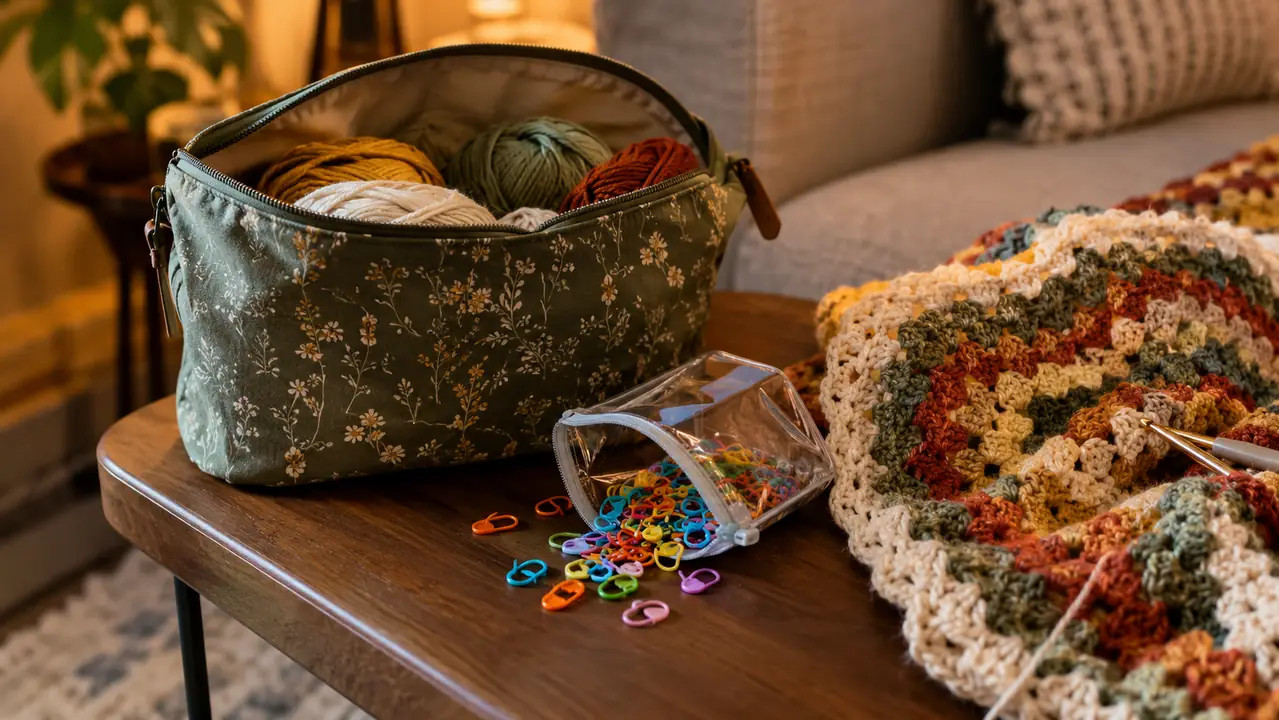
The pack comes with 100 markers in a mix of colors, and they arrive in a small plastic case that I replaced almost immediately with a zippered pouch. The case is fine for storage. It is not fine for reaching across the armrest one-handed while a cat sits on your lap.
The evening that sold me on them was a Tuesday in April. I was on row 63 of the blue blanket, the phone rang, and when I came back I had no idea whether I had just finished row 63 or was about to start it. I had left a HiMo marker clipped at the end of the last completed row, exactly the way the listing suggests, and for the first time in thirty years I did not have to count backward from the edge to find my place. I just picked up the hook and started row 64.
What Nobody Tells You About Locking Stitch Markers
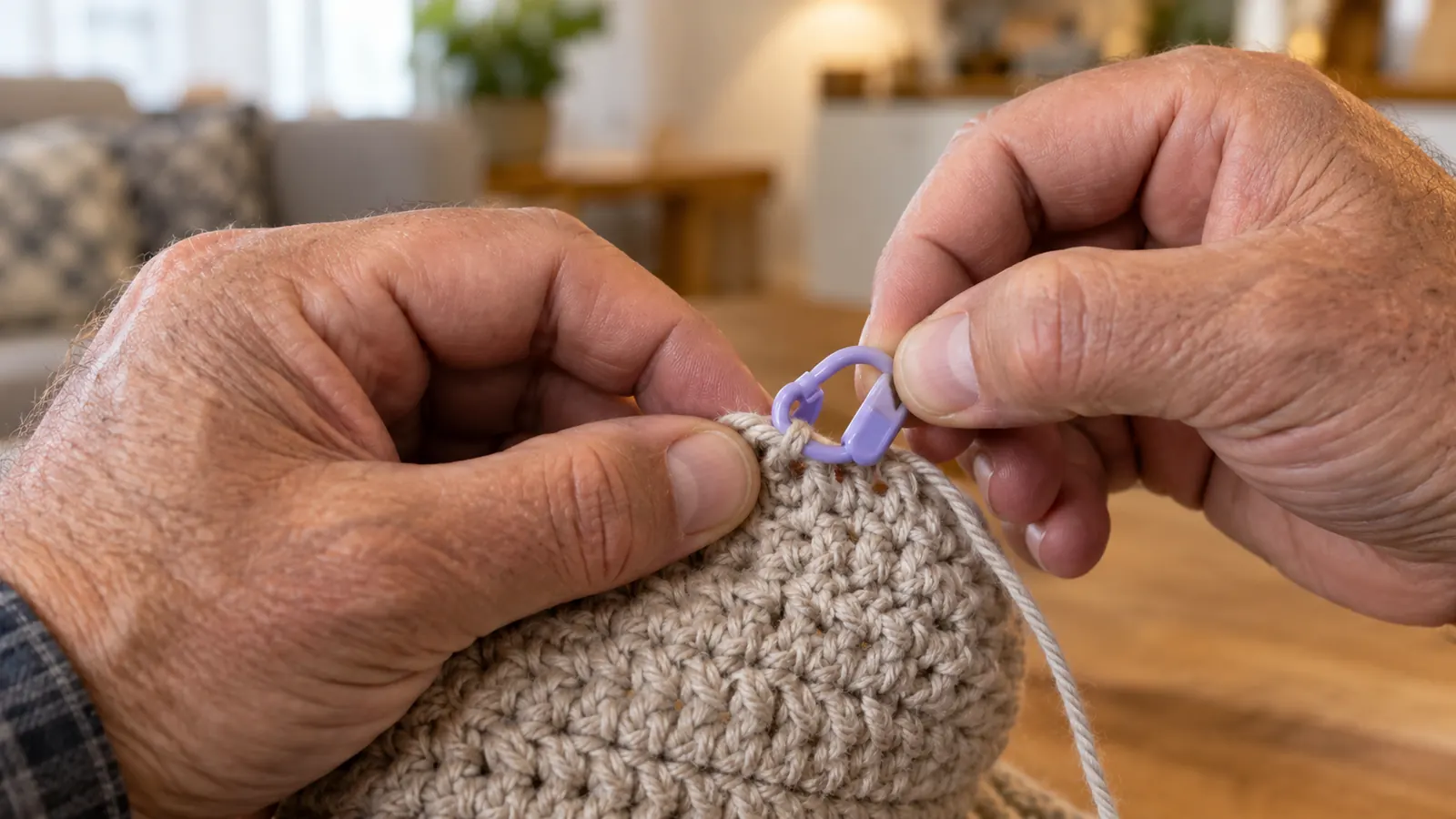
Here is the honest part. Locking stitch markers, including these, have a learning curve that the product photos do not show. You open them like a safety pin, but the wire is lighter and springier than a safety pin, and the little coil at the end can catch on your yarn if you clip them carelessly. I spent the first week closing them wrong and snagging the same few stitches over and over. The first time it happened, I was working on a dishcloth in the kitchen, and the marker caught the yarn, pulled a loop, and by the time I noticed, I had three rows of twisted stitches that took twenty minutes to untangle. Once I learned to open the marker fully before I clipped it, the snagging stopped.
The second thing nobody tells you is that not all 100 markers open the same way. Most of them snap open with a light squeeze. A handful are stiffer, and two or three are so tight that I set them aside rather than fight them in the middle of a row. I counted them one evening in July, mostly out of curiosity. Of the 100, I found seven that needed a firmer squeeze and three that I simply do not use. The three live at the bottom of the pouch, and I have thought about throwing them out, but they are small and harmless, so they stay. That is a small annoyance in a pack this size, but it is real, and I would rather tell you about it now than have you wonder if you got a bad batch.
The third thing is about the colors. The listing says mixed colors, and it means it. My pack came with a cheerful rainbow, which is exactly what I wanted for telling rounds apart. I use the colors on purpose now. Pink means the start of a round. Blue means the right side of the work. Yellow means this row is the last one before the border. I did not plan that system. It grew out of reaching for the same colors every night, and now it is automatic. If you are the kind of crocheter who wants a single, matching color for a gift project, you should know that you cannot choose the mix. You get what you get, and you will probably love it or find it charmingly chaotic.
Once I learned to open the marker fully before clipping it, the snagging stopped. That one habit fixed 90 percent of my frustration.
The Good
The HiMo markers lock. That sounds like the bare minimum, but it is the whole job, and they do it well. My sister lives about forty minutes away, and last spring I clipped a marker at the end of the last completed row of a baby blanket for her neighbor, folded the blanket into a tote, and did not think about it again until I unpacked it in her kitchen. The marker was still there, holding its place like it had been sewn in. A plain ring marker would have fallen out in the first mile.
They are also light. I have left a marker in a row for a week while I worked on other projects, and it did not stretch or distort the stitches. I weighed one on my kitchen scale just to be sure, and it came in at less than a gram. That is lighter than the plastic ring markers I used to keep, and much lighter than a safety pin. When I blocked the blue blanket in August, the places where markers had sat for weeks were indistinguishable from the rest of the fabric. That matters to me because I am careful about blocking and about not leaving dents in my work. The HiMo markers are the lightest stitch markers I own, and it shows.
And the price is honestly hard to argue with. For what a single fancy marked hook costs, you get a hundred markers that you can scatter across every project in the house. I keep a few in my project bag, a few in the armchair caddy, and a few in the kitchen drawer for when I am crocheting a dishcloth and the phone rings. I counted the other night while I was looking for a dropped hook. There are twelve in the pouch, six in the armchair caddy, four in the kitchen drawer, two clipped to projects in the guest room, and one in the pocket of my favorite cardigan. I have no idea where the other seventy-five are, and I do not care. That is the entire point of a hundred.
They are also easy to spot. The colors are bright enough that I can see a marker from across the room, which matters when Stormy decides the afghan on the back of the sofa is a bed and I need to find my place before I move her. I have never once had to hunt for a marker on a project. The color does the finding for me.
The Not-So-Good
The stiff ones. I keep coming back to them because they are the most honest thing I can tell you about this pack. Most of the 100 open easily. A small number do not, and when you are mid-row with a cat on your lap and a blanket across your knees, a stubborn marker is not a delight. It is a three-second pause in a rhythm you were enjoying. I have made my peace with the difficult few. They sit at the bottom of the pouch and I reach past them. But I want to be clear that this is a real thing, not a nitpick. If you buy this pack and one or two markers resist you, you did not get a defective batch. It is just how a hundred of anything shakes out.
The case is also not great. The little plastic box that the HiMo markers arrive in is fine for the drawer, but it does not travel well. The markers slide around inside, and if you open it upside down, you will be picking a hundred tiny colorful clips off the floor while your dog investigates. The hinge is the weak spot. After about a month of normal use, the lid no longer closed flush, so the case would not even stay shut in a drawer. That is not a reason to skip the product. The markers are the product. The case is just packaging, and you will replace it anyway. I solved it with a spare zippered pouch from my sewing basket, and I recommend you do the same.
One more honest note: these are small, and small means easy to lose. I have dropped markers between the cushion and the armrest of my chair, and I have found them weeks later while searching for a dropped hook. Just last week I found one in the pocket of the cardigan I wear in the evenings. It had been there since June. The marker still opened and closed perfectly, which tells me the wire holds its shape. Losing them is annoying. Finding them still working is a small comfort. That is not a flaw in the HiMo markers specifically. It is the nature of the tool, and it is worth knowing before you buy a hundred of anything small.
What I Liked
- The locking mechanism is real. Markers stay put through a forty-minute drive, a stuffed project bag, and a cat attack.
- Light enough to leave in stitches for a week without stretching or denting the fabric.
- Easy to open with a light squeeze, even with mild arthritis in my right thumb.
- A hundred markers means I never hesitate to use one, or ten.
- Bright mixed colors make it easy to tell rounds apart at a glance.
Where It Falls Short
- A few markers in every pack are stiff, and two or three are genuinely difficult to open.
- The plastic case does not travel well and the lid stopped closing flush after about a month.
- Small and easy to lose. I have found markers in cushions, cardigan pockets, and a water bowl.
- The wire snags yarn if you clip carelessly. There is a real learning curve.
- You cannot choose the color mix, so this is not the gift for a color-coordinated perfectionist.
How They Compare to the Alternatives I Tried
Before the HiMo pack, I used plain ring markers and, yes, safety pins. Safety pins work in a pinch, but they are heavy, they can rust, and they have a sharp point that will absolutely find your fingertip. I still have a scar on my left index finger from a safety pin that slipped while I was marking a row of a baby blanket in 2019. Ring markers are fine for marking a round, but they slide off the end of a row and they do not lock. If you have cats, you already know what happens to small shiny things that sit loose in a project bag. Romeo has a collection of ring markers under the sofa. I have given up on getting them back.
I also tried a small pack of a different brand of locking markers that a friend gave me, and the difference is mostly in the wire. The HiMo markers feel a little lighter and springier, which I like for leaving in my work. The tradeoff is that the lighter wire is the same wire that snags if you do not open the marker fully. Learn the habit, and the tradeoff mostly disappears. The other brand's markers were sturdier but heavier, and I noticed the weight when I left them in a row of fine yarn. Fine yarn does not forgive heavy hardware.
For my hands, which have mild arthritis in my right thumb, the HiMo markers are easy to open with a light squeeze. That was my biggest worry when I bought them, and it turned out to be a non-issue. The stiff ones I mentioned are the exception, and there are only a few in the pack. I open them with my left hand when my thumb is complaining, and it works fine.
Who This Is For
Buy the HiMo locking stitch markers if you crochet patterns with repeats, if you make amigurumi with rounds that all look the same, or if you have ever put a project down for the night and picked it up the next day with no idea which row you were on. They are also a genuinely nice gift for a newer crocheter, because a hundred markers feel like abundance, and abundance feels like permission to use them freely. I gave a pack to my sister in July, and she texted me a photo of her first finished dishcloth with a marker still clipped to the edge. She left it in on purpose, as a trophy.
Who Should Skip It
Skip them if you only ever crochet straight rows in a single color and you never lose your place. You do not need a hundred markers, and a single ring marker will serve you fine. Skip them if you are buying them as a gift for someone who is particular about color coordination, because you cannot choose the mix. And if you have very weak hands or significant arthritis in your fingers, I would start with a smaller pack to test the opening action before you commit to a hundred. The stiff ones are few, but they are not zero, and I would rather you know that before you buy.
The Bottom Line
The HiMo locking stitch markers are not a flashy product, and I would not describe them as exciting. They are a small, well-made tool that does its one job quietly and well. Six months in, I reach for them every single evening, and I have finished more projects this year than I did in the two years before. That is not because of the markers alone. But it is not a coincidence either.
The pack I still reach for every evening
If you lose your place, if you count rows in your head, if you have ever found a half-finished blanket and no memory of where you stopped, this is the small fix that actually stuck for me.
Amazon Check Today's Price on Amazon →